Battery Researcher

Lakshmi Surag Singavarapu

I develop electrolytes, cathode materials, and electrode processing methods for batteries. My work connects materials development with electrochemical testing, from coin cells to 3 Ah pouch cells.

Materials Science and Engineering, The Ohio State University

3Ah

Pouch cells fabricated in the dry room, scaled up from coin cells

2.5kg

Electrolyte prepared per batch

6min

Full charge of a 3 Ah pouch cell at 10C

26% → 69%

Capacity retention after 450 cycles in lithium-metal cells, through electrolyte design

Research

Electrolytes, Electrodes, and Cell Development

My research examines how material composition, interfacial chemistry, and electrode processing affect battery performance. The work spans lithium-ion, lithium-metal, solid-state, and structural batteries, with an emphasis on connecting laboratory results to larger cell formats.

General Motors R&D

Electrolytes and Interphases

Localized high-concentration electrolytes (LHCEs) for lithium-metal batteries and high-voltage LMR/graphite full cells.

Lithium-metal cells with NMC811 cathodes

26% → 69%capacity retention after 450 cycles with a dual-salt LHCE, compared with the reference electrolyte

Reference electrolyte
26%
Dual-salt LHCE
69%
Li-metal/NMC811 cells cycled at C/3. Measured values: 25.5% and 69.1%. Batteries & Supercaps 2026.

LMR/graphite full cells

0–45 °Celectrolyte formulation for high-voltage operation across the temperature range

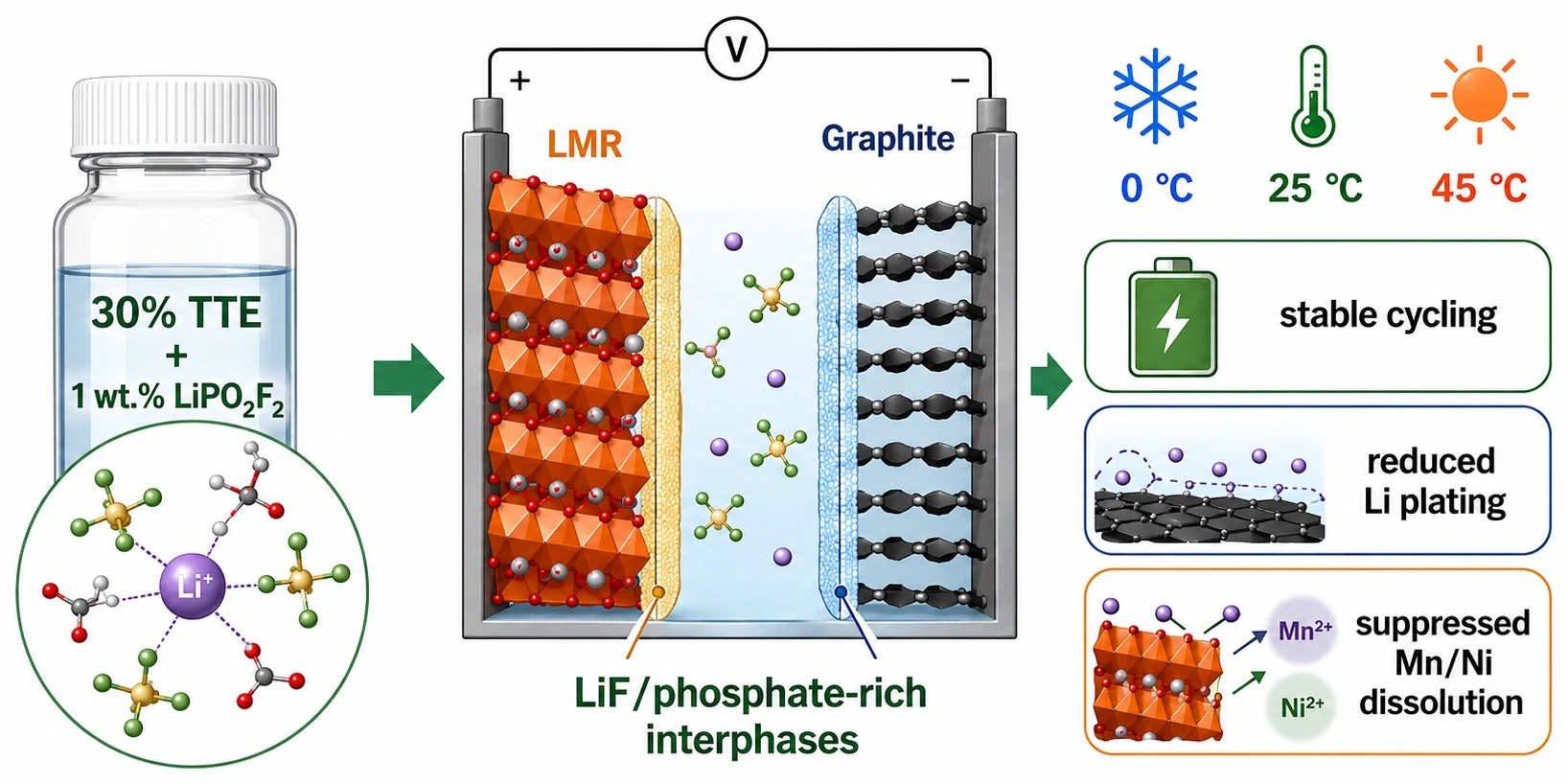
LHCE with 30% TTE diluent and 1 wt% LiPO2F2, tested at 0, 25, and 45 °C. ACS Applied Materials & Interfaces 2026.
Graphical abstract: an LMR/graphite full cell with a TTE-diluted electrolyte forming LiF- and phosphate-rich interphases, cycling from 0 to 45 °C.
Graphical abstract from ACS Applied Materials & Interfaces 2026. © The authors, licensed under CC BY 4.0.
Honda 99P Innovation Labs · General Motors R&D

Cathode Materials and Electrode Processing

Olivine and layered-oxide cathodes for improved rate performance, together with aqueous processing methods for high-voltage electrodes.

  • Anion and Cation Doping of LMFPAnion and cation doping to reduce Jahn–Teller distortion and improve manganese redox kinetics in LMFP cathodes.
  • LFP Synthesis from Iron MetalAn iron-metal precursor route that reduces raw-material cost by ~30% and delivers 130 mAh/g under 10C charging conditions.
  • Layered-Oxide Cathodes and UpcyclingCobalt-free and low-nickel cathodes for fast charging, alongside the conversion of spent NMC into single-crystal lithium- and manganese-rich cathodes.
  • Aqueous Binders for High-Voltage CathodesLiPAA-based LMR/graphite full cells showed ~4× the capacity retention of PVdF-based cells after 400 cycles. The electrodes were processed using water as the solvent.
ARPA-E · Honda · Stratus Materials

Fast Charging and Cell Scale-Up

Cobalt-free cathodes evaluated from coin cells to 3 Ah pouch cells, including charging at 10C.

Cell formats evaluated

  1. 1–3 mAh
    Coin cell
  2. 50 mAh
    Pouch cell
  3. 1 Ah
    Pouch cell
  4. 3 Ah
    Pouch cell
The 1 Ah and 3 Ah pouch cells were fabricated in the dry room at The Ohio State University Battery Cell R&D Center.
  • 6 minFull charge of a 3 Ah pouch cell at 10C
  • 1,000+Cycles in pouch cells, charged at 10C and discharged at C/3
From Lab to Pilot

My scale-up work connects materials development with electrode processing and cell validation. This includes electrolyte preparation in batches up to 2.5 kg and cell development from coin cells to 3 Ah pouch cells.

  • 2.5 kgElectrolyte per batch
  • 3 AhLargest pouch cell format
Toyota Research Institute of North America

Structural Batteries

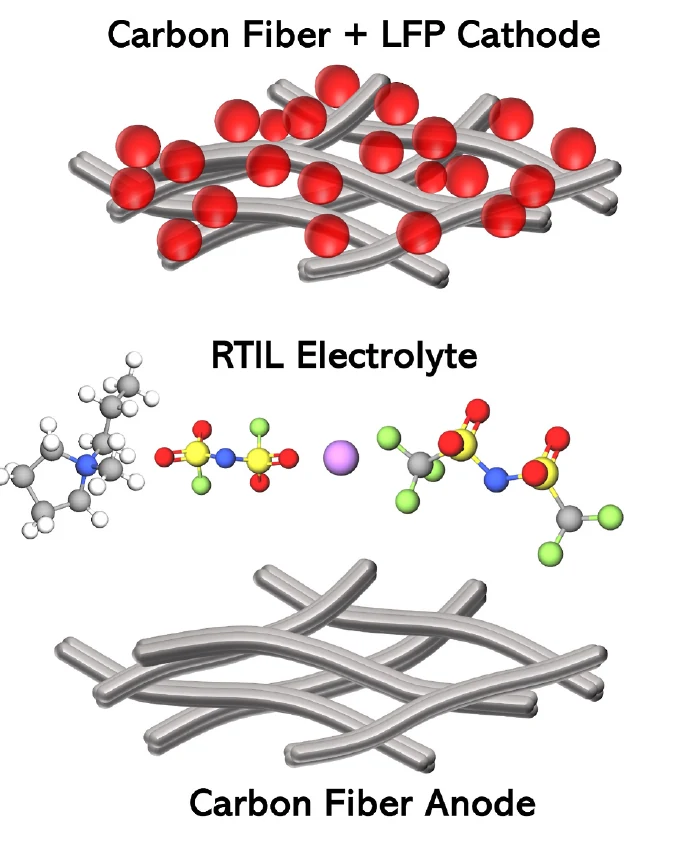
Carbon-fiber electrodes for batteries designed to store energy and carry mechanical load. The carbon fiber serves as both the anode and current collector and is paired with a non-flammable ionic-liquid electrolyte.

  • 83%Capacity retention after 100 cyclesIonic-liquid cell
  • 2.7×Capacity, compared with the current state of the artSolid-state cell
  • +50%Capacity in a four-cell stackSolid-state cell
Proposed structural cell: a carbon fiber cathode coated with LFP, an ionic liquid electrolyte, and a carbon fiber anode, with no aluminum or copper foil.
Scheme 2 reproduced from Singavarapu et al., Composites Science and Technology 2025, 259, 110952. © 2024 Elsevier Ltd. All rights reserved.

Supporting Methods

Slurry Rheology
Rheo-impedance and pulse-thixotropy measurements to evaluate slurry stability and identify suitable coating conditions.
Failure Analysis
EV-cell teardown, half-cell reconstruction, and surface and cross-sectional characterization to identify degradation mechanisms.
Data Analysis Tools
Python tools for processing cycling and impedance data and preparing figures and reports.
Publications · 11 journal papers · 3 invention disclosures

Publications and Inventions

ACS Applied Materials & Interfaces · 2026 Tailoring Localized High-Concentration Electrolytes for Wide-Temperature Operation of High-Voltage Full-Cells with Graphite Anodes Read summaryView paper ↗

Adding 1 wt% LiPO2F2 to an LHCE with 30% TTE improved LMR/graphite full cells at 0, 25, and 45 °C and suppressed Mn and Ni dissolution from the cathode.

Singavarapu, L. S.; Morchhale, A.; Jamil, M. F.; Tang, Z.; Yadav, V.; Darbar, D.; Qi, G.; Sayre, J.; Kim, J.-H.

View paper

Graphical abstract: an LMR/graphite full cell with a TTE-diluted electrolyte forming LiF- and phosphate-rich interphases, cycling from 0 to 45 °C.
Graphical abstract from ACS Applied Materials & Interfaces 2026. © The authors, licensed under CC BY 4.0.
Batteries & Supercaps · 2026 Synergistic Effects of LiTFSI and LiPF6 in Localized High-Concentration Electrolytes for Nickel-Rich Cathodes in Li-Metal Batteries Read summaryView paper ↗

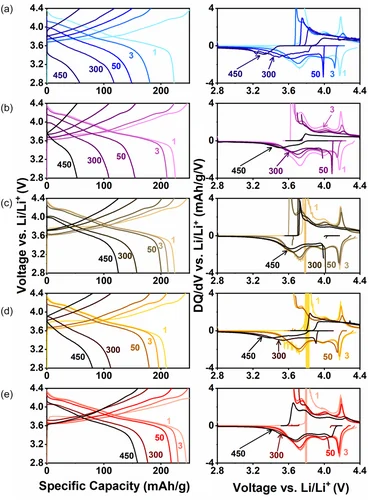
A dual-salt LHCE kept 69.1% capacity after 450 cycles at C/3 in NMC811 lithium-metal cells. The standard electrolyte kept 25.5%.

Singavarapu, L. S.; Morchhale, A.; Wang, T.; Khalifa, Y.; Sayre, J.; Kim, J.-H.

View paper

Figure 1: charge-discharge and dQ/dV curves comparing the dual-salt LHCE with reference electrolytes.
Figure 1 from Batteries & Supercaps 2026. © The authors, licensed under CC BY-NC-ND 4.0.
Composites Science and Technology · 2025 Room-Temperature Ionic Liquid Electrolytes for Carbon Fiber Anodes in Structural Batteries Read summaryView paper ↗

A non-flammable ionic liquid, 1 M LiTFSI in PYR13-FSI, kept 83% capacity over 100 cycles in LFP/carbon-fiber cells built without copper or aluminum foil.

Singavarapu, L. S.; Gilmore, P.; Yap, J. W.; Khalifa, Y.; Gandhi, U.; Arthur, T. S.; Sayre, J.; Kim, J.-H.

View paper

1 M LiPF6 in EC/EMC, flammable baseline
87%
1 M LiTFSI in PYR13-FSI
83%
0.3 M LiTFSI in PYR13-FSI
67%
Capacity retention after 100 cycles at 25 °C. Redrawn from values in the paper.
Co-Authored Publications (8)
RSC Advances · 2026 Cost Effective Synthesis of LiFePO4 Cathodes Using Iron Metal Precursor Read summaryView paper ↗

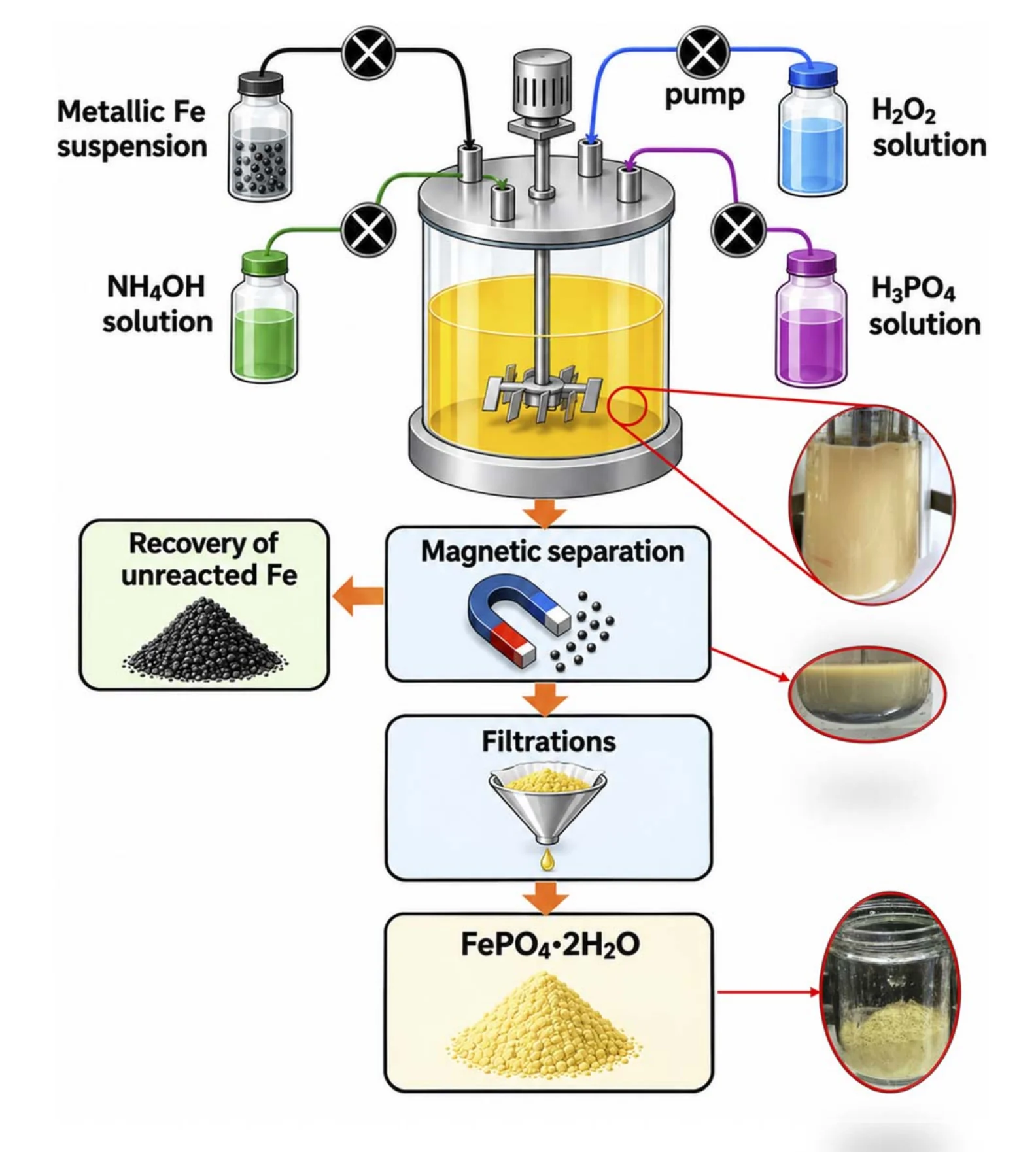
A scalable wet-chemical route to nano-LFP from metallic iron: 160 mAh/g initially, over 90% capacity after 200 cycles, and about 130 mAh/g at 10C charging. Recycled iron cuts raw material cost by nearly 30%.

Jamil, M. F.; Singavarapu, L. S.; Morchhale, A.; Tang, Z.; Chen, M.; Huang, X.; Wang, L.; Qi, G.; Kim, J.-H.

View paper

Scheme 1: synthesis of iron phosphate dihydrate from metallic iron in a chemical reactor, with magnetic separation to recover unreacted iron, then filtration.
Scheme 1 from RSC Advances 2026. © The authors, licensed under CC BY 4.0.
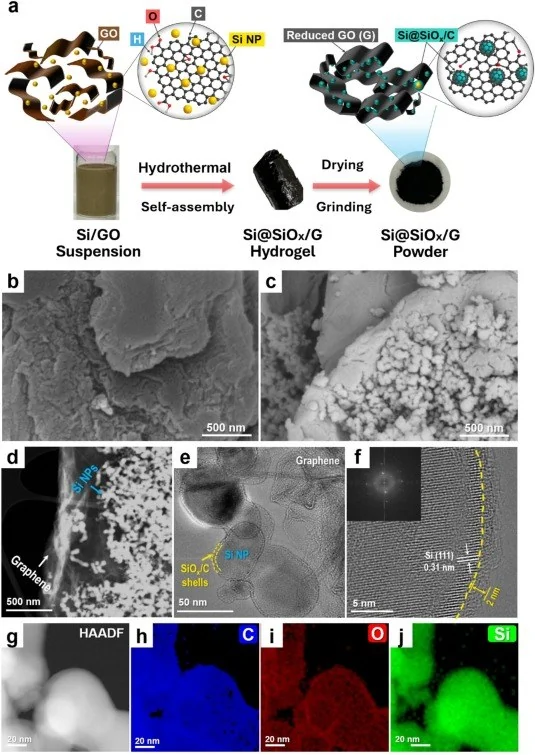
Journal of Energy Storage · 2026 Extreme Fast-Charging Silicon Anodes Enabled by SiOx/C-Shell Encapsulation in Reduced Graphene Oxide Read summaryView paper ↗

SiOx/C-shelled silicon anchored on reduced graphene oxide charges and discharges at 10C (about 18.8 A/g) and suppresses contact-impedance growth.

Jang, D.; Yap, J. W.; Singavarapu, L. S.; Alam, S.; Calderon Ortiz, G. A.; Morchhale, A.; Choi, J.; Wang, T.; Park, S.; Hwang, J.; Sayre, J.; Park, S.; Kim, J.-H.

View paper

Figure 1: synthesis scheme and electron micrographs of SiOx/C-shelled silicon in reduced graphene oxide.
Figure 1 from Journal of Energy Storage 2026. © The authors, licensed under CC BY 4.0.
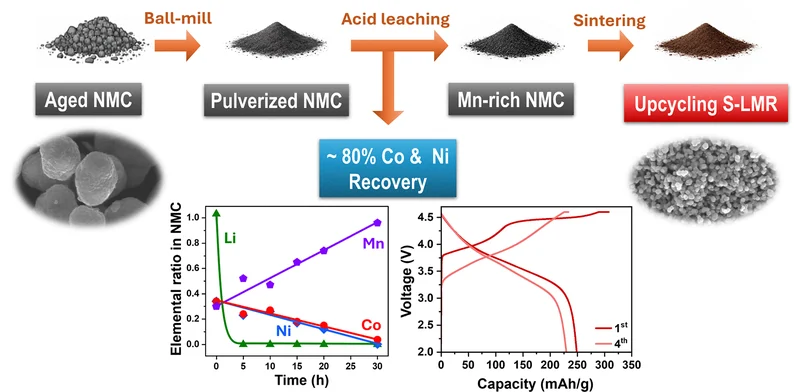
Chemical Communications · 2026 Selective Transition Metal Leaching Strategy for Upcycling LiNi1/3Co1/3Mn1/3O2 into Single-Crystal Li- and Mn-Rich Cathodes Read summaryView paper ↗

Selective leaching of transition metals from spent NMC111, with the residue upcycled into a single-crystal Li- and Mn-rich cathode.

Jang, D.; Sablak, J.; Singavarapu, L. S.; Morchhale, A.; Shin, H.; Kim, J.-H.

View paper

Graphical abstract: ball milling, acid leaching, and sintering route that upcycles aged NMC into single-crystal LMR.
Graphical abstract from Chemical Communications 2026. © The authors, licensed under CC BY 3.0.
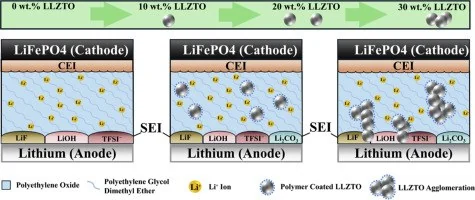
Electrochimica Acta · 2026 Effect of Li6.4La3Zr1.4Ta0.6O12 on the Stability of Plasticized PEO-Based Composite Polymer Electrolytes for Lithium Metal Batteries Read summaryView paper ↗

10 to 20 wt% LLZTO gave the most stable lithium interface, with symmetric cells running 1,000 cycles. At 30 wt%, direct Li/LLZTO contact degraded it.

Stone, C.; Singavarapu, L. S.; Morchhale, A.; Lalgudi, R.; Khalifa, Y.; Kim, J.-H.; Sayre, J.

View paper

Graphical abstract: effect of LLZTO content on the SEI in PEO-based composite electrolyte cells.
Graphical abstract from Electrochimica Acta 2026. © The authors, licensed under CC BY 4.0.
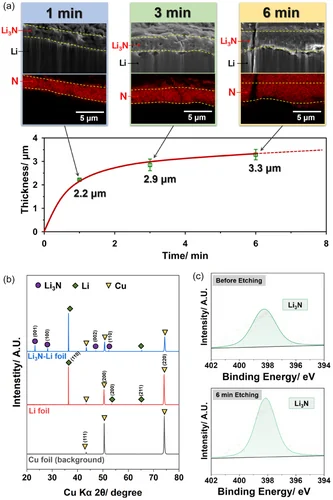
Small Structures · 2026 Stabilizing Lithium Metal Surface in Solid-State Batteries via Single-Step Gas-Phase Synthesis of Li3N Interfacial Layer Read summaryView paper ↗

A Li3N layer about 3 µm thick, grown on lithium in one gas-phase step inside a nitrogen glovebox, suppresses voids and microcracks at the argyrodite interface.

Tang, Z.; Morchhale, A.; Ham, S. Y.; Singavarapu, L. S.; Choi, J.; Rao, L.; Zhang, M.; Brooks, C. J.; Meng, Y. S.; Sayre, J.; Kim, J.-H.

View paper

Figure 1: Li3N interfacial layer growth on lithium, thickness over time with XRD and XPS.
Figure 1 from Small Structures 2026. © The authors, licensed under CC BY 4.0.
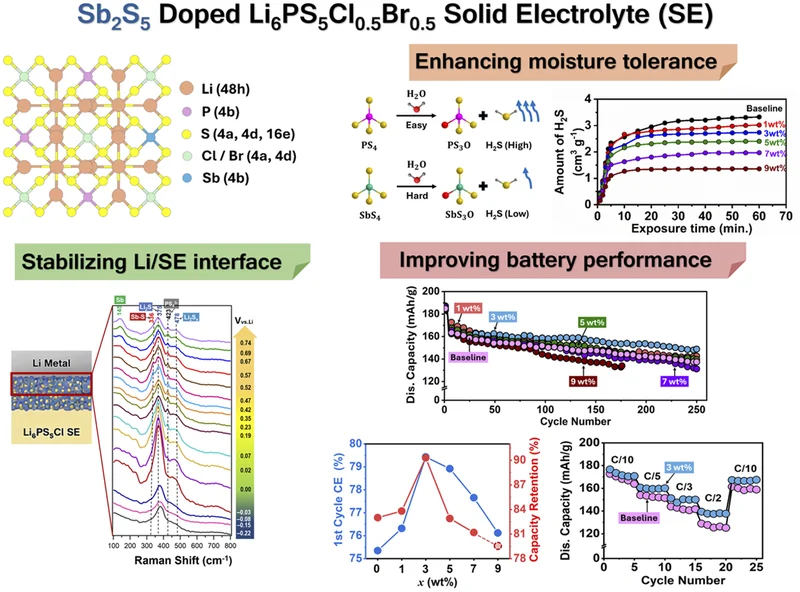
Journal of Materials Chemistry A · 2026 Sb2S5-Doped Li6PS5Cl0.5Br0.5 Solid Electrolyte with Enhanced Moisture Tolerance and Interfacial Stability for All-Solid-State Batteries Read summaryView paper ↗

3 wt% Sb2S5 doping raised ionic conductivity by 36%, suppressed moisture-induced decomposition, and reached a critical current density of 1.7 mA/cm2.

Morchhale, A.; Jamkar, S.; Singavarapu, L. S.; Tang, Z.; Rao, L.; Ghahremani, R.; Liu, K.; Farahati, R.; Kalra, V.; Kim, J.-H.

View paper

Graphical abstract: Sb2S5-doped argyrodite solid electrolyte improving moisture tolerance, interface stability, and cycling.
Graphical abstract from Journal of Materials Chemistry A 2026. © The authors, licensed under CC BY 3.0.
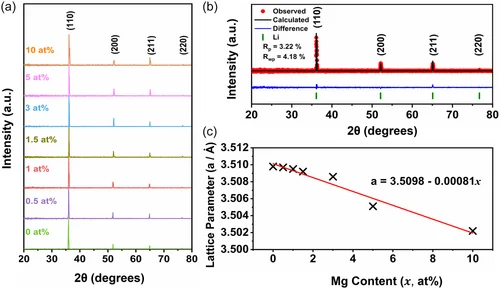
Small Structures · 2026 Impact of Li–Mg Alloy Anodes on Performance of Sulfide-Based All-Solid-State Batteries Read summaryView paper ↗

Li–Mg alloys with 0.5 to 1.5 at% Mg gave the best interfacial stability, with critical current density near 1.8 mA/cm2 at 1.5 at%.

Morchhale, A.; Chang, C. Y.; Thapa, S.; Singavarapu, L. S.; Jamil, M. F.; Chen, Y. T.; Luo, A.; Kim, J.-H.

View paper

Figure 1: XRD patterns and lattice parameter versus Mg content in Li-Mg alloy anodes.
Figure 1 from Small Structures 2026. © The authors, licensed under CC BY 4.0.
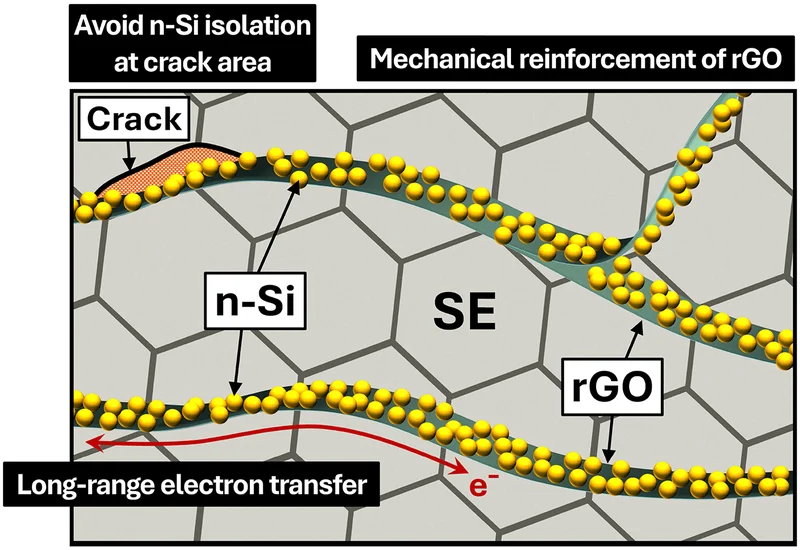
Chemical Communications · 2025 Nano-Silicon/Reduced Graphene Oxide Composite Anodes for High-Performance All-Solid-State Batteries Read summaryView paper ↗

SiOx-shelled nano-silicon anchored on reduced graphene oxide delivered 44.8% more capacity at 1C charging than plain nano-silicon in sulfide all-solid-state cells.

Morchhale, A.; Jang, D.; Yap, J. W.; Singavarapu, L. S.; Alam, S.; Hwang, J.; Park, S.; Kim, J.-H.

View paper

Graphical abstract: nano-silicon anchored on reduced graphene oxide stays connected at cracks.
Graphical abstract from Chemical Communications 2025. © The authors, licensed under CC BY-NC 3.0.
Under review
  1. Multifunctional Aqueous Binders for Stable High-Voltage LMR Cathodes in Lithium-Ion Batteries.Journal of Energy Storage
In preparation
  1. Coupled Rheological and Impedance Analysis of Formulation- and Solids-Loading-Dependent Behavior in Silicon Oxide Anode Slurries.
  2. Separator-Free Multilayer Structural Batteries Using Glass-Fiber Veils (working title).
Invention disclosures (3)
  1. Methods for Making Powder Materials with Controlled Nano- and Micro-Particle Morphology.PCT/US2025/040001 · Provisional 63/677,563 · The Ohio State University T2024-398
  2. A Water-Based Electrode Manufacturing Method.P111996-PRI-NP-US01 · pending
  3. Sine Wave Wipe Separator for Pampers Dispenser.The Ohio State University invention disclosure T2022-285 · 2022
Conference Presentations (11)
  1. Dual-Salt Localized High Concentration Electrolyte Enabling High-Voltage Cathodes in Lithium Metal Batteries.EMC 2026 · June 24–26, 2026 · Michigan
  2. Carbon Fiber-Based Multifunctional Structural Batteries with Room-Temperature Ionic Liquid Electrolytes.EMC 2026 · June 24–26, 2026 · Michigan
  3. Dual-Salt Localized High-Concentrated Electrolytes for High-Voltage Lithium Metal Batteries with NMC811 Cathodes.ECS Meeting Abstracts 2025, MA2025-02 (2), 264 · doi
  4. Dual-Salts Localized High-Concentration Electrolyte for Li- and Mn-Rich High-Voltage Cathodes in Lithium Metal Batteries.ECS Meeting Abstracts 2025, MA2025-02 (2), 326 · doi
  5. Room Temperature Ionic Liquid Electrolytes for Enhanced Structural Batteries with Carbon Fiber Anodes.ECS Meeting Abstracts 2025, MA2025-02 (1), 87 · doi
  6. Optimizing Cobalt-Free and Low-Nickel Cathodes for 10C Extreme Fast Charging Lithium-Ion Batteries.ECS Meeting Abstracts 2025, MA2025-02 (3), 546 · doi
  7. Comparative Study of Sb2S5 or Sb2O5 Substitution in Li6PS5Cl0.5Br0.5 for All Solid-State Batteries.ECS Meeting Abstracts 2025, MA2025-02 (3), 563 · doi
  8. PEO-PEGDME-LLZTO Composite Polymer Electrolytes for Solid-State Lithium Batteries.ECS Meeting Abstracts 2025, MA2025-02 (3), 564 · doi
  9. Impact of Li-Mg Alloy Anodes on All Solid-State Battery Performance.ECS Meeting Abstracts 2025, MA2025-02 (3), 641 · doi
  10. Encapsulated Silicon Nanoparticles Anchored on Reduced Graphene Oxide as a High-Performance Anode for Li-Ion and All Solid-State Batteries.ECS Meeting Abstracts 2025, MA2025-02 (9), 1088 · doi
  11. Cost-Effective Synthesis and Recycling of LiFePO4 Cathode Material Using Iron Metal Powder.ECS Meeting Abstracts 2025, MA2025-02 (1), 57 · doi
About

Experience and Education

About

I am a Ph.D. candidate in Materials Science and Engineering at The Ohio State University. My research focuses on electrolytes, electrode materials, and processing for lithium-ion, lithium-metal, solid-state, and structural batteries.

I work with automotive and materials-industry collaborators on materials development, cell fabrication, and failure analysis. My experience includes coin and pouch cells, dry-room processing, and electrolyte scale-up.

Experience
  1. 2023 – PresentGraduate Research AssistantEnergy Innovation Lab, The Ohio State UniversityAdvisors: Dr. Jung-Hyun Kim and Dr. Jay Sayre
  2. 2022Research and Product Development InternNavaFlex Inc. (formerly FlexEnergy LLC)
  3. 2021 – 2022Undergraduate Research AssistantCLEAR Lab, The Ohio State UniversityAdvisors: Prof. Ardeshir Contractor and Dr. Navni Verma
Education · The Ohio State University
  • Ph.D.
    Materials Science and EngineeringAdvisors: Dr. Jung-Hyun Kim and Dr. Jay Sayre
    April 2027
  • M.S.
    Materials Science and Engineering
    August 2026
  • B.S.
    Materials Science and EngineeringResearch Distinction
    December 2022
Skills
Cell Fabrication and Electrode Processing
Coin cells and pouch cells up to 3 Ah; dry-room and glovebox assembly; coating, calendering, and roll-to-roll processing; structural cells.
Electrochemical Testing and Analysis
Cycle-life and rate testing; EIS and DRT; GITT; cyclic voltammetry; differential-capacity analysis. Instruments: BioLogic, Arbin, and Gamry.
Materials Characterization
SEM, TEM, FIB, and EDS; XRD and Rietveld refinement; XPS; Raman and FT-IR; DSC and TGA; ICP-OES/MS.
Battery Materials and Chemistries
Lithium-metal and solid-state batteries; silicon anodes; LMR, LMFP, and cobalt-free cathodes; localized high-concentration, ionic-liquid, and polymer electrolytes.
Synthesis and Formulation
Co-precipitation, sol–gel, solid-state, and hydrothermal synthesis; electrolyte batch preparation; slurry rheology; aqueous electrode processing.
Software
Python and Streamlit; Thermo-Calc; SOLIDWORKS, AutoCAD, and CATIA; PLC programming.
Contact

Get in Touch

I’m interested in battery R&D roles and research collaborations involving materials development, electrode processing, and cell scale-up.

Your details are used only to reply to you. See Privacy.